This Saturday, artists Hilary Powell and Dan Edelstyn are auctioning off their work from the past decade and a half. The reason? To help fund a community-led renewable power station in Nigel Farage’s Clacton constituency. Former YBA Gavin Turk will be wielding the gavel and the couple hope to raise at least £250,000 for the project.
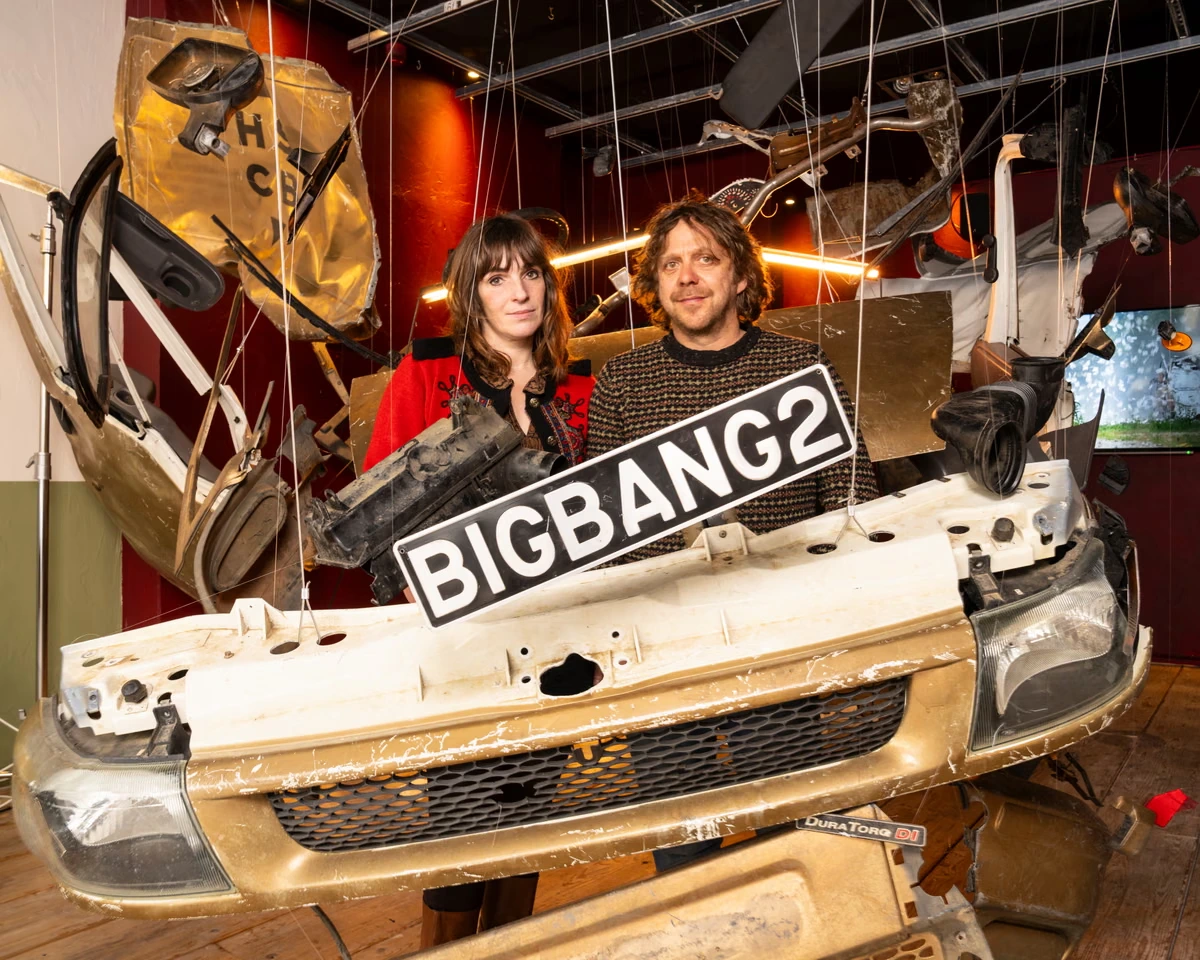
The big-ticket item going under the hammer will be the remnants of a gold Ford Transit van containing £1.2m in fake banknotes that the pair blew up in London’s Docklands in 2019 as the climax – or money shot, if you will – of Bank Job, a film about their attempts to fight toxic debt culture with art, a battle that involved printing cash to wipe out more than £1m debt.
Van wreckage and charred banknotes were gathered up and reconstituted as an Alexander Calder-like mobile that, for a while, hung in Cambridge’s Fitzwilliam Museum. Now, for perhaps £100,000, this sculpture could be the centrepiece of your living room. (You’d need a pretty big living room.)
Powell hopes that the exploded van will be bought by a public institution, and has been contacting the likes of the V&A and the Arts Council to see if they are interested in buying it for their collections. “I’ve spent a week sending off many, many emails and then getting quite patronising replies,” she says.
Also up for grabs will be bottles of vodka from a 2009 project for which Edelstyn traced his family’s Jewish ancestry back to a Ukrainian village. Once there, he attempted to revive his ancestors’ distillery – and ended up selling high-end Zorokovich 1917 vodka to Selfridges.
Alongside the in-person auction, the pair are hosting an online iteration that will run until 31 May. “We have £750 at the moment,” says Edelstyn. “We need about 250 times that to fund the project.”
But what exactly is the point of building a power station in Clacton? Edelstyn refers to a report by climate campaigners DeSmog claiming that Reform UK has received more than £2.3m from oil and gas interests, highly polluting industries, and climate science deniers since December 2019, amounting to 92% of the party’s donations. “Building a community-owned renewable power station in Reform’s first seat,” he says, “is the most direct response we can think of.”
The pair call what they do Method Art. Which is? “Living ideas into existence rather than representing them. The work is the action: abolishing real debt, building a real power station, planning a real community-owned renewable in Clacton. Artists not as commentators but as people who get the thing built.”
The pair’s conviction that art should change the world came after Edelystn made a film about his Ukrainian vodka enterprise, and had an existential crisis. It was brought about, he says, by a Guardian review (it happens) that called him a businessman rather than an artist. “Just calling me that made me wonder what I was doing.”
Two writers, George Orwell and Viktor Frankl, helped him to come up with answers. “In [the 1946 essay] Why I Write, Orwell laid out all the different reasons people do so: to participate in the crazy world around us; to look clever; to take revenge on people who told you you’d never amount to anything. And then there was the pure joy of aesthetic expression. Orwell suggested that there can be all these desires in varying degrees in one person as they create, and that thought inspired me.”
Holocaust survivor, psychiatrist and neurologist Frankl inspired Edelstyn in a different way. “In his book Man’s Search for Meaning, Frankl disagreed with Freud and Adler and said the desire to lead a meaningful life was the primary driver for human lives. I thought that was beautiful and it helped me want to participate and live meaningfully, usefully.”
In the middle of his crisis, he and Powell learned about an American group that was buying and abolishing debts. “That was the inspiration for Bank Job,” says Powell. “We were going to really participate and consciously shape the world we live in, engage with political and economic arguments. And it was from there that Power Station came about.”
He is referring to how, on the street where they live in London’s Waltham Forest, the couple helped fund, build and operate a community-owned solar power station. How was this possible? “There are about 20,000 high net worth people across Britain who buy shares in community benefit societies that fund these sort of things,” says Powell. “Shareholders put in the capital that buys the solar panels, then the host building gets solar panels for no upfront cost, but buys the energy from the community benefit society at a cheaper rate than it would cost from the grid.”
Edelystn says more than 130 streets in Waltham Forest have signed up to follow suit, with another 50 across the UK.
The proceeds from Saturday’s auction won’t directly fund the mooted power station’s solar installations. Rather, they will bankroll the work the pair are doing to set up in Clacton and to make a film about the project. If they sell the blown-up van, the proceeds will be core funding for their not-for-profit production company. The funding for the power station will come from issuing shares and other fund-raising to create a community benefit society.
The idea of going off-grid may seem appealing to those of us struggling with rising fuel bills, but there is a problem with this model. “Most solar co-ops prefer to work with councils or long-term businesses that have security and stability,” says Edelstyn. “Domestic is really complicated because you get mixed tenureships in one street. Some people are renting, some people are in council houses, and some people have got mortgages. That’s hard to organise.”
Yet, inspired by Frankl, the pair are determined to make the seemingly impossible exist. “That utopian sensibility, against all the odds, is definitely why we are the kind of artists we are.”
Their Power Station film has already influenced UK community energy policy: apparently, Ed Miliband came to visit the pair two weeks ago. Now they are taking their model to the stronghold of Reform UK and hoping that there will be enough local enthusiasm to make it work there, ideally on Clacton’s Electric Avenue, which runs from the pier and includes Reform UK’s local office. Winning over locals is key to the project’s success. To that end they’ve arranged a screening of the film at Walthamstow’s Forest Cinema and invited councillors and other bigwigs from the Essex seaside resort to attend. But aren’t the couple missing a trick? Surely their first port of call should be to approach Clacton’s MP for some funding. After all, the £5m Farage received from a Thai-based crypto billionaire suggests he isn’t short of a bob or two. “I mean, he would presumably want to get the bills down of everyone on the street where the power station would be,” muses Edelstyn. “So why wouldn’t he put some of his money behind what we’re doing?”
Quite. Mr Farage, if you’re reading this, do consider getting in touch with the artists to support what, I’m sure you’ll agree, is just what your constituency needs at this difficult time.