Triumph, which has just opened at London’s Almeida theatre, is Caryl Churchill’s latest piece of explosive minimalism. Running at just 20 minutes, it skewers contemporary barbarism without mentioning the names of Trump, Putin or any of the other supposedly strong national leaders. It works through historical analogy and is a reminder that Churchill – while “always ahead of the game” in the words of the play’s director, James Macdonald – has in recent years developed a form of elliptical drama for which the apt word might be compressionism.
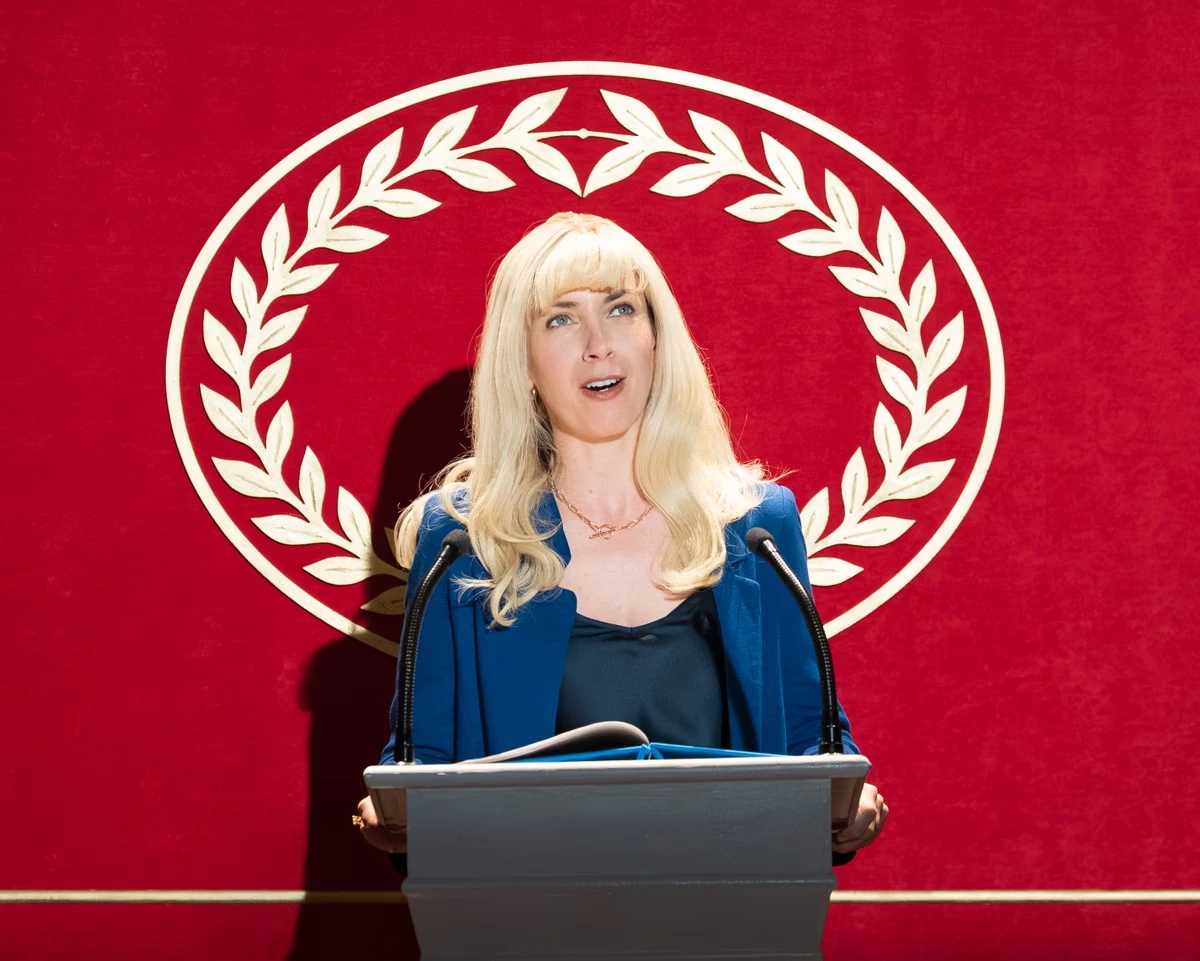
At the heart of Churchill’s new play is an edgy romance between a male journalist and a female press officer who dons a blond wig for her screen appearances and who is a vigorous apologist for a cruel, vindictive, narcissistic emperor.
At first she merrily trumpets his more acceptable achievements: pearls imported from Britain, gold from the temples of Gaul, statues erected to his own glory. But through her lover she learns of the monstrosities of the regime she represents – such as prisoners trapped in claustrophobic cages and sawn in half – and reveals the truth on camera.
Expecting retribution, she is instead showered with praise as the ratings rocket and she is told: “The people like a strong emperor.” Standing at a lectern backed by imperial purple and speaking in an overtly American accent, Kate O’Flynn shows perfectly the way the authentic human being emerges from the glamorised robot who speaks for power: in James Macdonald’s production she even looks uncannily like the most recent and short-lived White House incumbent, Katie Zacharia.
So what is Churchill up to? Since all the crimes perpetrated by the emperor are drawn from Suetonius’s The Twelve Caesars, it is clear that a parallel is being drawn between then and now.
Two examples prove the point. When Triumph’s emperor reminds his wife that he has the power of life and death over her, it is a direct echo of Caligula’s threat to a spouse that “This beautiful throat will be cut whenever I please”. At another point a fisherman, who has terrified the emperor by presenting him with a giant mullet, finds his face rubbed in it. Having foolishly thanked heaven that it wasn’t a crab, he then finds the emperor ensuring that his features are badly scarred by a giant crustacean: a slice of whimsical sadism from the reign of Tiberius.
Lest anyone think that Churchill is overstating the case by linking Roman and contemporary decadence, one has only to look at recent events. We live in a world where the idea of livestreaming a military execution, although now abandoned, was originally endorsed by President Trump and his defence secretary, Pete Hegseth. We have also seen ICE agents shooting nonviolent protesters, while fishermen in the Caribbean have been killed by American troops on the totally unproved grounds that they were drug smugglers. Churchill’s point in Triumph is that today governments in the western world not only commit acts of extreme brutality: they also attempt to massage them through skilled media presentation.
All this is conveyed in a short, sharp shock of a play that is proof of Churchill’s restless experimentalism. But while she never writes the same play twice, I see a clear division between her earlier and later work. In the 1970s and 80s she wrote a series of momentous plays that used a range of expansive devices to expose the defects of our society. Latterly she has created a number of works in which formal brevity is accompanied by a bleak worldview. That may be an oversimplified view of a complex artist but what I see in the later Churchill is a form of cosmic minimalism.
In the earlier period she was clearly animated by the absurdities, inequities and injustices she found in British life. That was evident in Cloud 9, about to be revived by the National Theatre and which I signally failed to understand on its first appearance in 1979. The first half is a very funny expose of Victorian Anglo-Saxon attitudes in which imperialist supremacy is linked to sexual dominance. “There is something dark about women that threatens what is best in us,” one male colonialist tells another. The second half transports us to the more libertarian sexual relationships of the 1970s but, while Churchill palpably applauds progress, she implies that the old class barriers have by no means disappeared.
That was even more obvious in Top Girls. Appearing in 1982, it brilliantly nailed the Thatcherite ethos by suggesting that the replication by women of the male success ethic was pointless. It began with the famous dinner-party scene in which five notable women from history were seen as both radical pioneers and social victims. It went on to explore the contradictions of the modern working woman. But the visceral showdown came in the final scene where the striving Maggie Thatcher-worshipping Marlene confronted her working-class sister, Joyce.
What was great was Churchill’s understanding of both points of view. Joyce’s sense of deprivation led to a rancorous bitterness while the outwardly successful Marlene was conscious of the dubious bargain she had made in sacrificing her child to her career. As Lesley Manville pointed out when introducing a reshowing of the play on BBC Four, this was one of the great plays of the century. I suspect it will last longer than Churchill’s vibrant satire on the greed-is-good philosophy of the City of London in Serious Money. I loved the play in 1987 but seeing it revived recently by a young company called Mad Spirit I felt that it belonged to its moment. Today, I felt, Churchill would be writing about City jitters, cyber-plots and fears of financial collapse.
One of Churchill’s qualities, in fact, is her nimbleness of spirit and ability to respond to the times – even to be way ahead of them. Far Away, which premiered in 2000, was a startling evocation of the threat both of localised fascism and of global crisis. The first scene, in which a niece tells her aunt that she has seen her uncle beating people and bundling them into lorries, has acquired an ugly resonance in an age when the far-right sanctions violence towards immigrants. But the final scene offered a terrifying image of a world at war and of nature absorbed into a cycle of unending destruction. I wondered at the time if there was something determinist about Churchill’s vision of catastrophe. A quarter of a century later I find myself admiring her foresight.
The same is true of A Number, first seen at the Royal Court in 2002 with Michael Gambon and Daniel Craig and revived many times since. In the play a father confronts three of his adult sons: from the cells of one taken into care at the age of four a doctor has created a series of clones. But this was less a play about the ethics of cloning than about the nature of identity. If the first son was disturbed, was it the result of a depressive mother or paternal neglect? If the second cloned son was his physical match but psychological opposite, was that because of scientific skill or a stable environment? In a 60-minute play Churchill was posing fundamental questions that have grown ever more urgent in an age when AI poses a threat to human survival.
Churchill’s compressionism was equally apparent in Escaped Alone, from 2016, which showed a group of women amiably chatting in a sunlit garden. While talking of times past, they also relished the benefits of living today: “whole worlds in your pocket,” said one of mobile phones. But in their midst was a septuagenarian Cassandra who offered a vision of global catastrophe: a world of flood, fire, thirst and starvation where 80% of food was diverted to TV studios and “commuters watched breakfast on iPlayer on their way to work”.
This strikes me as quintessential Churchill. She is a writer with a strong sense of life’s quotidian pleasures and its unexpected delights. But she is also more alert than most to the possibility, whether from geopolitics, climate crisis or technological advance, that we are speeding towards the abyss. To express this, as she does, in works that get briefer and more concentrated with each year makes her the most pungent theatrical prophet alive today.