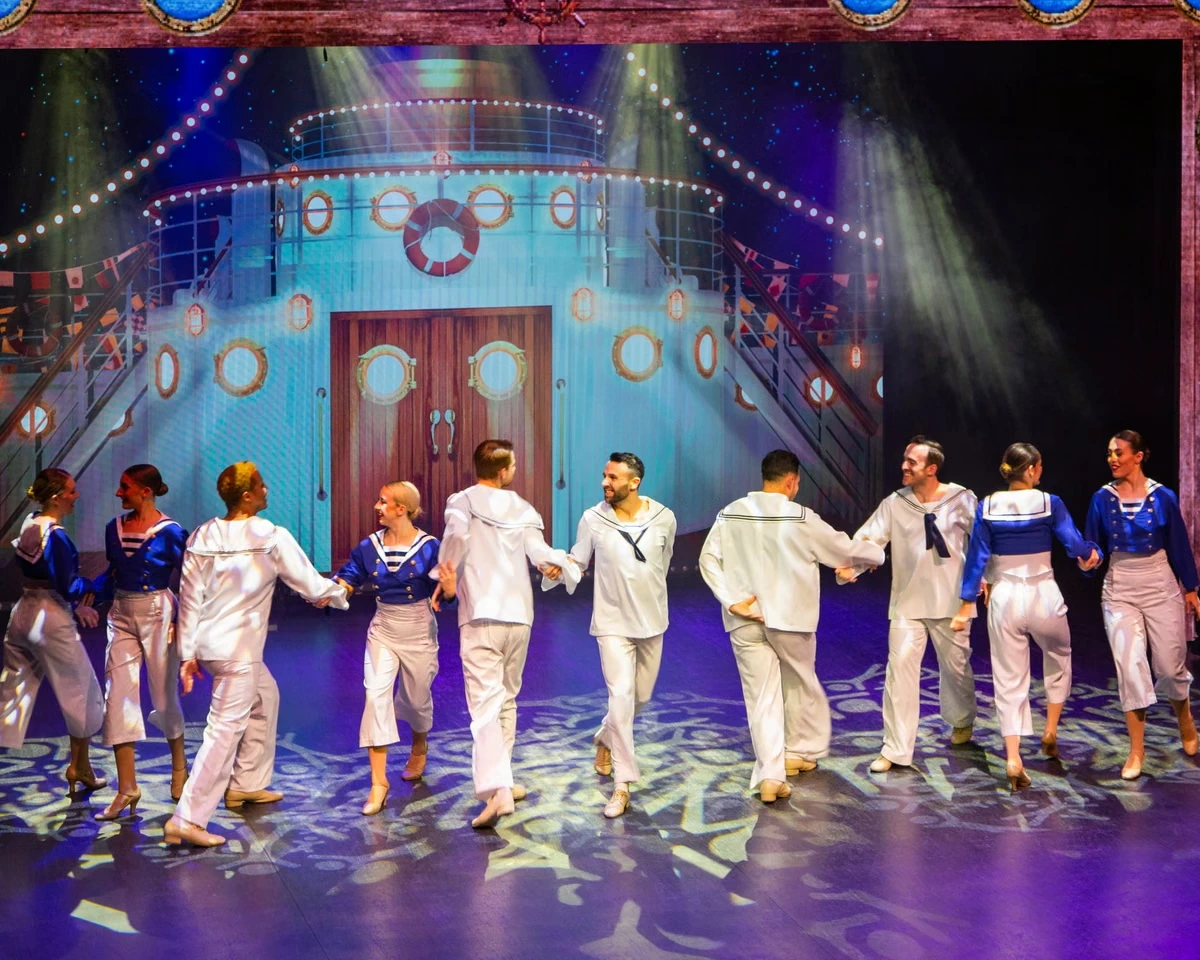
The phrase “cruise ship entertainment” conjures vivid images, even to those who have never set foot on an oceangoing vessel. Starry backcloths, sequined frocks, tunes and croons from yesteryear, the lite-ent values of the 1970s preserved in aspic. Perhaps those stereotypes held water way back when the singer Jane McDonald ruled the reality TV waves. But – lazy thinking ahoy! – do they still?
Look at the shows currently a-sail on the high seas, from the Olivier award-winning 9/11 musical Come from Away, to hip theatre-maker Emma Rice’s acclaimed Brief Encounter. And look at the onboard production values, which “way surpass what you see in London theatres”, says Susannah Daley of Peel Entertainment, which provides shows for the Ambassador cruise line. “These ships are now being built with theatre in mind, to a really high spec, to hold between 600 and 1,000 people. What can be produced in them is pretty phenomenal.” Producer David Pugh, a veteran of the West End who has collaborated with Cunard cruises, says: “These are probably the most technical theatres, in terms of lighting and sound, that you’ve ever seen outside of the best theatres in the world.”
Brief Encounter is Pugh’s. He has also recently delivered the RSC’s production of The Constant Wife onboard Cunard cruises. Meanwhile, Cunard is now well established as the “headline partner” of theatre’s most prestigious gong show, the Olivier awards – while Peel has just run a competition (which received 260 applications) for new plays to be performed at sea.
It’s all a far cry from the days when cruise ships ranked alongside Butlin’s for arts industry prestige. “It’s really shifted,” says Cat Robey, Cunard’s senior entertainment development manager (and a former deputy director of London’s Jermyn Street theatre). “No one says ‘No’ any more. It’s now much more, ‘I’ve heard it’s brilliant and I’d love to do it.’”
When Peel took to the sea 26 years ago, says Daley, “people tended to think of cruises as girls with feathers and some crooner. But we were told, ‘No, we want to get away from that whole cheesy reputation.’” Back then, cruises laid on a handful of performances per week. Now there are multiple shows daily. These include shows in repertory by resident companies, and others by visiting outfits moonlighting at sea. All artforms are welcome: Cunard currently offers immersive theatre, for example, from the company behind wraparound performance experiences Peaky Blinders: The Rise and Doctor Who: Time Fracture.
That, says Daley, is because the mainstream theatre industry has woken up to what can be achieved on cruise ships. On the one hand, it’s about meeting new audiences – “People are seeing theatre on a cruise who may never have been to the theatre before” – and in large numbers. “You’ve got a guaranteed audience,” says Daley, “and where on earth would you get that? We can get 600 people coming to a play in the afternoon. In the evening, we may get 1,200 people over two sittings. This is a fabulous opportunity for your work to be seen.” It’s a great chance for artists to flex their performing muscles, too. “Cruise offers, especially to younger performers, massive variety. Because you have to sing rock one day, opera another day and act in a play the next. You’re stretching yourself all the time.”
It’s increasingly the case, says Robey at Cunard, that customers are booking cruises based not solely on their sunkissed itineraries, but on the theatre onboard. “We absolutely know from guest feedback and booking trends that performances draw bookings,” she says, citing themed event voyages that include “London Theatre at Sea” (Southampton to New York, May 2026), not to mention Virgin Voyages’ seven-night comedy cruise (tagline: “Laugh your aft off!”).
Peel’s and Ambassador’s recent playwriting prize, meanwhile, reflected a hunger among passengers for new bespoke drama onboard. “You try and get into a lounge to watch them sometimes and it’s absolutely packed,” says Daley. The prize winner, a thriller titled Venison by Edinburgh-based Huw Turnbull, is being staged on the waves this summer. “We hope the competition will make people aware,” says Daley, “of a growing opportunity at sea for writers, directors and all sorts of creative talents.”
There are, of course, downsides. “A ship doesn’t wait for anybody,” says Daley. “Whenever we’re sending out scenery, costumes and lighting, it has to arrive on time at whatever port we’ve agreed. We’ve got some freight which at the moment is floating around Spain because it’s not allowed to dock there.”
There are other logistical quirks. Rehearsals must take place at antisocial hours, because the theatre is in fairly constant use. Shows require ruthless editing to fit allotted running times. And the motion of the ocean isn’t always a performer’s friend. Pugh remembers rehearsing the acclaimed Regency comedy Pride & Prejudice* (*sort of), “on the Bay of Biscay, gale force seven. Furniture goes one way, the actors go the other, this girl gets hit on the head, and there’s blood.” Cue a medical lockdown and a long delay to the opening of the show.
But there are further reservations about the cruising experience that make bloodied heads pale by comparison. The comedian John Tothill’s new show, nominated for the Edinburgh comedy award last summer, recounts a recent experience gigging at sea. It was not a positive one. While Tothill is not obvious cruise ship material – his comedy is self-parodically erudite – he made a real effort to make it work. “I honed a routine down to my most down-the-line accessible material. Gone was all my stuff about the Lutheran reformation. I went in armoured with what I thought was this patronisingly accessible act.”
Then he went onstage. And what happened “wasn’t just bombing” he says. “It was like a religious silence every night. A kind of existential darkness. I have never experienced anything like it before or since. Being met with total bafflement and confusion which, across the course of an hour, boiled over into angry contempt on both sides. It was like a culture war playing out in real time. I felt that [the audience] had unfairly caricatured me as a rubbish, lazy young comedian. And I returned the favour. We just didn’t see eye to eye.”
To Tothill, cruise ship audiences trend reactionary (“the things that go down really well are still tribute acts for bands in the 80s”), and the breadth of entertainment available militates against quality. To Daley, that’s an out-of-date stereotype: “There’s as many varied guests onboard as there are in any other walk of life.” Recent research backs that up: a 2023 report by the Cruise Lines International Association showed that millennials made up 22% of passengers that year, with gen Z accounting for a further 14%.
The old-duffer stereotypes may be wearing thin – although Daley and Robey admit that when programming performances onboard, it’s best to avoid particularly challenging work. “What you don’t want is anything that’s sectarian in any way that would divide an audience,” says Daley, while Robey adds: “We’re with people who are on holiday, ultimately. They’re here to have a good time.”
Producer Pugh’s misgivings relate to working practices and standards at sea. After signing his own contract with (US-owned) Cunard, he became aware that the company’s resident performer and stage manager contracts were non-union, and that the jurisdiction of the actors union Equity does not extend into international waters. While Pugh acknowledges that pay rates onboard are seldom a problem, he expresses concern for the overall wellbeing of artists, who can get too easily isolated and trapped in these jobs. Cunard made no comment when invited to respond to these issues.
Equity was involved in negotiations when, for example, the RSC partnered with Cunard. Speaking to the Guardian, the union acknowledges the difficulty of imposing UK working standards on global seafaring, but says its interactions with the industry have been broadly positive. Negotiations are relatively straightforward, it says, when shows transfer wholesale from land – and that, increasingly, seems to be where entertainment at sea is coming from.
“When I started this job,” says Robey, “I came in with the mindset that cruise ship entertainment was a bit passé and end-of-the-pier. But things have massively changed. There’s a realisation that it is actually unbelievably varied, with so much opportunity to push boundaries in different artforms. I now have companies and West End producers asking to come aboard.”